skip to main |
skip to sidebar
Prayers today: By your blood, O Lord, you have redeemed us from every tribe and tongue, from every nation and people: you have made us into the kingdom of God, alleluia. (Rv 5:9-10)
Father, in your plan of salvation your Son Jesus Christ accepted the cross and freed us from the power of the enemy. May we come to share the glory of his resurrection, for he lives and reigns with you and the Holy Spirit, one God, for ever and ever. Amen. Alleluia.
St. Bernadette Soubirous (1844-1879)

Bernadette Soubirous was born in 1844, the first child of an extremely poor miller in the town of Lourdes in southern France. The family was living in the basement of a dilapidated building when on February 11,1858, the Blessed Virgin Mary appeared to Bernadette in a cave above the banks of the Gave River near Lourdes. Bernadette, 14 years old, was known as a virtuous girl though a dull student who had not even made her first Holy Communion. In poor health, she had suffered from asthma from an early age. There were 18 appearances in all, the final one occurring on the feast of Our Lady of Mt. Carmel, July 16. Although Bernadette's initial reports provoked skepticism, her daily visions of "the Lady" brought great crowds of the curious. The Lady, Bernadette explained, had instructed her to have a chapel built on the spot of the visions. There the people were to come to wash in and drink of the water of the spring that had welled up from the very spot where Bernadette had been instructed to dig. According to Bernadette, the Lady of her visions was a girl of 16 or 17 who wore a white robe with a blue sash. Yellow roses covered her feet, a large rosary was on her right arm. In the vision on March 25 she told Bernadette, "I am the Immaculate Conception." It was only when the words were explained to her that Bernadette came to realize who the Lady was. Few visions have ever undergone the scrutiny that these appearances of the Immaculate Virgin were subject to. Lourdes became one of the most popular Marian shrines in the world, attracting millions of visitors. Miracles were reported at the shrine and in the waters of the spring. After thorough investigation Church authorities confirmed the authenticity of the apparitions in 1862. During her life Bernadette suffered much. She was hounded by the public as well as by civic officials until at last she was protected in a convent of nuns. Five years later she petitioned to enter the sisters of Notre Dame. After a period of illness she was able to make the journey from Lourdes and enter the novitiate. But within four months of her arrival she was given the last rites of the Church and allowed to profess her vows. She recovered enough to become infirmarian and then sacristan, but chronic health problems persisted. She died on April 16, 1879, at the age of 35. She was canonized in 1933.
The Holy Gospel of Jesus Christ accoprding to Saint John (6.1~15)
Some time after this, Jesus crossed to the far shore of the Sea of Galilee (that is, the Sea of Tiberias), and a great crowd of people followed him because they saw the miraculous signs he had performed on the sick. Then Jesus went up on a mountainside and sat down with his disciples. The Jewish Passover Feast was near. When Jesus looked up and saw a great crowd coming towards him, he said to Philip, Where shall we buy bread for these people to eat? He asked this only to test him, for he already had in mind what he was going to do. Philip answered him, Eight months' wages would not buy enough bread for each one to have a little! Another of his disciples, Andrew, Simon Peter's brother, spoke up, Here is a boy with five small barley loaves and two small fish, but how far will they go among so many? Jesus said, "Make the people sit down." There was plenty of grass in that place, and the men sat down, about five thousand of them. Jesus then took the loaves, gave thanks, and distributed to those who were seated as much as they wanted. He did the same with the fish. When they had all had enough to eat, He said to his disciples, "Gather the pieces that are left over. Let nothing be wasted." So they gathered them and filled twelve baskets with the pieces of the five barley loaves left over by those who had eaten. After the people saw the miraculous sign that Jesus did, they began to say, "Surely this is the Prophet who is to come into the world." Jesus, knowing that they intended to come and make Him king by force, withdrew again to a mountain by Himself.
The Loaves
(Homily by Fr. E. J. Tyler)
In the Gospel of St John our Lord is presented as going back and forth between Galilee and Jerusalem in Judea. He comes from Galilee to Judea for the baptism of John and to begin his public ministry. He returns to Galilee where he changes the water into wine at Cana. Then “after not many days” at Capernaum, he “went up to Jerusalem.” There he cleanses the Temple, gives his discourse to Nicodemus and sojourns in the environs in Judea. Then he leaves for Galilee, passing through Samaria where he converts the woman at Sychar, together with many of her townspeople. Back again in Galilee where he cured the nobleman’s son, he returns to Jerusalem for “a feast of the Jews.” Then we notice — in the chapter from which our passage today is drawn — that he is back in Galilee again, where he works the miracle of the loaves for the five thousand men. Despite the danger, he returns to Jerusalem for the Feast of Tabernacles and teaches in the temple. There he encounters his enemies, disputes with them, teaching and healing. An attempt is even made to stone him. It is mentioned that he is in Jerusalem for the Feast of the Dedication — so possibly he has stayed from the Feast of Tabernacles to the Feast of the Dedication. He escapes an attempt to arrest him, going “beyond Jordan.” Then he returns to Bethany where he raises Lazarus, and then enters the City for his final redemptive act. Of course, no one would maintain that St John is meaning to present this sequence of events as exactly reflecting all historical details. It is a broad picture made up of significant “signs” and teachings. The feature I am drawing attention to here is the frequent reference to Jerusalem, its feasts and its Temple. These made up the centre of the religion of the chosen people and our Lord is portrayed as acknowledging this by his actions. The point is, I suggest, that many of the “signs” Christ works show that all of this will be transformed in the new dispensation. There will be a new centre, a new temple, new feasts, a new sacrifice and Jesus Christ himself will be its heart and soul.
We are surely alerted to this in our Lord’s first public intervention in Jerusalem, as presented by St John. It occurs in the second chapter, “and the Passover of the Jews was near at hand, and Jesus went up to Jerusalem.” Christ cleanses the Temple and points to himself — to his body — as the new Temple. After the Temple — his body — is destroyed, he will raise it up in three days. Inasmuch as this announcement occurs near the feast of the Passover, and inasmuch as Christ’s death itself would be a new Passover, we are reminded not only of the new Temple but also of the new Passover of his death that is coming. There will not only be a new Temple, but a new Passover, because there will be a new liberation from slavery. All of this brings us to our Gospel passage today. We notice that just as this first public manifestation of Christ in the Temple (John 2:13-25) was introduced by the circumstance that “the Passover of the Jews was at hand,” so the event portrayed in today’s Gospel (John 6:1-15) is also introduced by the same circumstance, expressed even in a very similar Greek wording. The Passover of the Jews was near at hand. Our Gospel event today then, also points to a coming transformation of the meaning of the Passover. Christ proceeds to feed the multitudes with a mere handful of food — just as the feast of the Passover is nigh. We remember the children of Israel being led out of slavery into the wilderness on their sojourn to the Promised Land. On the way they were fed from Heaven with manna sent by God. A new liberation is now coming, a new Passover, a new departure from the land of slavery in sin to the Promised Land of life in God. For the journey a new manna would be given, the true bread from heaven. That heavenly Bread is the body of Christ. He is our life. In the former event, the new Temple will be the body of Christ, risen from the dead. In the present event, the new manna will be the body of Christ, risen from the dead. Christ is destined to be man’s true life, his all, his means of life in God and his means of contact with God. The new religion revealed by God consists in union with Christ who is our Temple and our means of communion with the Father.
The miracle done, the people recognized that Christ was the promised Prophet, and the promised King — the Messiah. But they had entirely mistaken notions of the Prophet and the Messiah. They thought he would bring a new temporal liberation, of the same order only greater than that delivered by Moses. But no. Jesus Christ the Son of God had come to liberate the world from sin. He would do this by the sacrifice of his body as a victim on the Cross. The sacrificed Jesus is the ever-present sacrifice of the new people. He is its new Temple, and is its new and constant heavenly food for the journey to the Promised Land. We are speaking of the Holy Eucharist, the summit and source of revealed religion and of our entire Christian life.
~~~~~~~~~~~~~~~~~~~~~~~~~~~~~~~~~~~~~~~~~~~~~~~~~~~~~~~~~~~~~~~~~~

Character
Don't let your life be sterile. Be useful. Blaze a trail. Shine forth with the light of your faith and of your love.
With your apostolic life wipe out the slimy and filthy mark left by the impure sowers of hatred. And light up all the ways of the earth with the fire of Christ that you carry in your heart.
(The Way,1)
Prayers today: When you walked at the head of your people, O God, and lived with them on their journey, the earth shook at your presence, and the skies poured forth their rain, alleluia. (See Ps 67:8-9, 20)
God of mercy, may the Easter mystery we celebrate be effective throughout our lives. Grant this through our Lord Jesus Christ, your Son, who liveth and reigneth world without end. Amen. Alleluia.
Blessed Caesar de Bus (1544-1607)

Like so many of us, Caesar de Bus struggled with the decision about what to do with his life. After completing his Jesuit education he had difficulty settling between a military and a literary career. He wrote some plays but ultimately settled for life in the army and at court. For a time life was going rather smoothly for the engaging, well-to-do young Frenchman. He was confident he had made the right choice. That was until he saw firsthand the realities of battle, including the St. Bartholomew's Day massacres of French Protestants in 1572. He fell seriously ill and found himself reviewing his priorities, including his spiritual life. By the time he had recovered Caesar had resolved to become a priest. Following his ordination in 1582, he undertook special pastoral work: teaching the catechism to ordinary people living in neglected, rural, out-of-the-way places. His efforts were badly needed and well received. Working with his cousin, Caesar developed a program of family catechesis. The goal — to ward off heresy among the people — met the approval of local bishops. Out of these efforts grew a new religious congregation: the Fathers of Christian Doctrine. One of Caesar's works, Instructions for the Family on the Four Parts of the Roman Catechism, was published 60 years after his death. He was beatified in 1975.
The Holy Gospel of Jesus Christ according to Saint John(3.31~36)
The one who comes from above is above all; the one who is from the earth belongs to the earth, and speaks as one from the earth. The one who comes from heaven is above all. He testifies to what he has seen and heard, but no-one accepts his testimony. The man who has accepted it has certified that God is truthful. For the one whom God has sent speaks the words of God, for God gives the Spirit without limit. The Father loves the Son and has placed everything in his hands. Whoever believes in the Son has eternal life, but whoever rejects the Son will not see life, for God's wrath remains on him.
Wrath (Homily by Fr. E. J. Tyler)During the third decade of the nineteenth century in England, the Oxford Movement was rapidly developing. It was spearheaded by a small group of Oxford dons at the centre of which was John Henry Newman — but he was one of a tight group of high-minded friends. From their pens flowed published tracts, books, sermons and reviews. They aimed at a spiritual renewal of the Anglican Church, understood by them as involving a revival of the catholic ethos of the Caroline divines of the seventeenth century — which itself referred back to the Church of the Fathers. It was a catholic revival, and its final upshot was the passing over of its leader and certain others to communion with the Church of Rome. At one point in the Movement — it was during the 1830s — Newman received a visit from some members of Cambridge University, and the subject of the liberalism of certain Cambridge men came up. He observed that what they needed in their religion was a lot more fear. They needed to be more fearful of God. The fear of God was a theme which Newman returned to at various times in his famous sermons. He claimed that modern man too often looks on God as absolutely benevolent, even in respect to sin. The modern image of God is such that we do not fear him, and in fact we take little notice of him. There is a corollary to this. It is that modern man shows relatively little concern for personal and public “sin,” and yet he becomes profoundly incensed at personal and public immorality. Consider the proportion of space given to news of unethical, immoral behaviour of individuals and institutions, and to ethical failures in government or public persons. Such failures are roundly condemned (as often they should be), illustrating the objective reality of the moral realm. People fear being exposed as immoral for this will involve the wrath of society. But they have few apprehensions in respect to “sin,” because this involves merely the supposed wrath of God. The modern media will not accuse a person of being “sinful,” only immoral or unethical. What is behind this is the absence of God. While the wrath of society is feared, the wrath of God is not.
This is to say that one of the most obviously counter-cultural aspects of revealed religion in the modern day is the revelation of the wrath of God in respect to sin. God revealed himself as pure love, as is shown in the person of Jesus Christ, and as is summed up in the terse definition of St John in one of his Letters — that God is love. But modern secular man, for whom God is absent from daily life, has little difficulty with the notion that God is love. This is because he imagines the love of God as a benign acceptance of everything. God is just a benevolent backdrop to life and reality. There are, he deems, intolerable evils in the world and this discounts the proposition that there is an infinite and holy God active in the world. But to the extent that the thought of God is admitted by him at all, he takes it to be a thought of mere benevolence. In fact, this is a facet of the relegation of God beyond the margins of the world of daily life. But it has been revealed that God’s love is a holy love, a mighty love for all that is good. It is a love that will not bear sin. God will not accept the slightest sin and this non-acceptance of sin is what the inspired Scriptures call his wrath. Sin will ultimately be completely rejected by the all-holy God, and this rejection will be a manifestation of divine wrath. Wrath is the converse of a love that is holy. There is a parallel in the indignation of modern man and media towards unethical practices because of the harm it inflicts on others. So too with God in respect to sin. While society is alert to morality and ignores “sin,” God sees every sin and, because of his love for the sinner, hates his sin. All this is to say that we need to recover a sense of the wrath of our loving God. His wrath is his judgment on sin. In our Gospel passage today, St John refers to the sin of rejecting the Son of God. It will incur the wrath of God. “Whoever believes in the Son has eternal life, but whoever rejects the Son will not see life, for God's wrath remains on him” (John 3: 31-36).
The person who has little fear of God is a foolish person. The Scriptures are replete with references to the wrath of God on sin. Compare the teaching of our Lord as it is presented in the four Gospels with that of any of the prophets. Christ’s references and warnings of the judgment of God and of the punishment of Hell are far more telling than anything in the Old Testament. In an age that ignores the living God, we ought give special thought to the divine judgment. It will help us turn away from sin and believe the Good News of God’s infinite love for all.
Prayers today: Let us shout out our joy and happiness, and give glory to God, the Lord of all, because he is our King, alleluia. (Rv 19:7, 6)
All-powerful God, help us to proclaim the power of the Lord’s resurrection. May we who accept this sign of the love of Christ come to share the eternal life he reveals, for he lives and reigns with you and the Holy Spirit, one God, for ever and ever. Amen. Alleluia.
St. Martin I (d. 655)
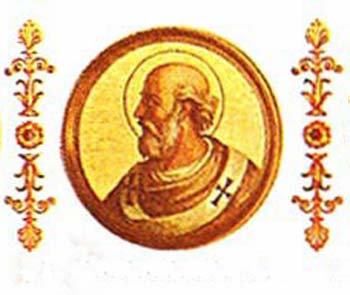
When Martin I became pope in 649, Constantinople was the capital of the Byzantine empire and the patriarch of Constantinople was the most influential Church leader in the eastern Christian world. The struggles that existed within the Church at that time were magnified by the close cooperation of emperor and patriarch. A teaching, strongly supported in the East, held that Christ had no human will. Twice emperors had officially favoured this position, Heraclius by publishing a formula of faith and Constans II by silencing the issue of one or two wills in Christ. Shortly after assuming the office of the papacy (which he did without first being confirmed by the emperor), Martin held a council at the Lateran in which the imperial documents were censured, and in which the patriarch of Constantinople and two of his predecessors were condemned. Constans II, in response, tried first to turn bishops and people against the pope. Failing in this and in an attempt to kill the pope, the emperor sent troops to Rome to seize Martin and to bring him back to Constantinople. Martin, already in poor health, offered no resistance, returned with the exarch Calliopas and was then submitted to various imprisonments, tortures and hardships. Although condemned to death and with some of the torture imposed already carried out, Martin was saved from execution by the pleas of a repentant Paul, patriarch of Constantinople, who was himself gravely ill. Martin died shortly thereafter, tortures and cruel treatment having taken their toll. He is the last of the early popes to be venerated as a martyr. The breviary of the Orthodox Church pays tribute to Martin: “Glorious definer of the Orthodox Faith...sacred chief of divine dogmas, unstained by error...true reprover of heresy...foundation of bishops, pillar of the Orthodox faith, teacher of religion.... Thou didst adorn the divine see of Peter, and since from this divine Rock, thou didst immovably defend the Church, so now thou art glorified with him.”
The Holy Gospel of Jesus Christ according to Saint John (3.7b~15)
Jesus said to Nicodemus, "(Do not wonder that I told you,) 'You must be born again.' The wind blows wherever it pleases. You hear its sound, but you cannot tell where it comes from or where it is going. So it is with everyone born of the Spirit." "How can this be?" Nicodemus asked. "You are Israel's teacher," said Jesus, "and do you not understand these things? I tell you the truth, we speak of what we know, and we testify to what we have seen, but still you people do not accept our testimony. I have spoken to you of earthly things and you do not believe; how then will you believe if I speak of heavenly things? No-one has ever gone into heaven except the one who came from heaven— the Son of Man. Just as Moses lifted up the serpent in the desert, so the Son of Man must be lifted up, that everyone who believes in Him may have eternal life."Faith (Homily by Fr. E. J. Tyler)In our Gospel passage today, Nicodemus is in wonderment at Christ’s statement that in order to enter the Kingdom of God a man must be born again. The Christian is so accustomed to this teaching that he has probably lost the sense of its radical newness. It is evident from Nicodemus’s difficulty that Christ gave every impression that he meant literally and exactly what he said. A new birth was required. Our Lord did not “tone down” his language, but spoke plainly. We are reminded of our Lord’s teaching in the Synagogue (chapter 6 of the same Gospel) in which he announced the doctrine of the Eucharist. He stated that unless people ate his flesh and drank his blood, they would have no life in them. Why could he not have toned down his language and couched it in less startling terms? It would not have been so divisive. He would have retained his disciples. But no. So important was it for salvation that our Lord, who had demonstrated his almighty power and his truthfulness, judged it necessary to reveal so amazing a doctrine clearly and publicly. His hearers could not understand how such a thing could be done, for all they could think in terms of was the eating and drinking of their everyday experience. So they gave up on Jesus Christ. They could not understand, so they refused to believe. It would seem that the same temptation faced Nicodemus when he heard the doctrine from the lips of Christ of the rebirth that was necessary to see the Kingdom of God. He could not understand, because all he could think of was the normal experience of a person’s birth to life. How could a person possibly be “born again”? I cannot see how it can be, so I cannot see how I can believe. That is the temptation facing the one who hears the proclamation of revealed religion. There are so many things we cannot possibly understand in revealed religion. We cannot understand Christ’s being God and Man. We cannot understand his being one of three divine persons in the one God. We cannot understand the Eucharist. We cannot understand — though we can apprehend — the rebirth by water and the Spirit.
It brings us to the fundamental importance of faith in revealed religion. By means of faith in the word of Jesus Christ we come to know things which we cannot understand. But as our Lord points out to Nicodemus, the reasonableness of this faith is itself not beyond our understanding. By that I mean that it is not hard to understand that we can come to know things which we do not understand, and on the word of one who knows. For instance, there are many things in our ordinary everyday experience which we do not understand, but which we have no doubt exist and occur — on the word of those who know. “Do not wonder that I told you, 'You must be born again.' The wind blows wherever it pleases. You hear its sound, but you cannot tell where it comes from or where it is going. So it is with everyone born of the Spirit.” Our Lord refers to the wind — a natural process many may not understand, certainly in the time of our Lord. No one might understand why it is that polyps causing terminal cancer in a person’s bowel are continuing to appear, but the patient believes — and knows — on the word of the doctor that steps must now be taken. Our Lord is saying that matters of ordinary life show that faith in the word of the one who knows is perfectly reasonable, even if one cannot understand such matters. Faith in matters supernatural is perfectly reasonable, then. Our Lord tells Nicodemus that he and his own know these things — “we speak of what we know,” our Lord states. Perhaps the plural pronoun is an allusion to our Lord’s communion with his disciples and an allusion to the future Church that will speak in his name, and of which he is the head. “I tell you the truth, we speak of what we know, and we testify to what we have seen, but still you people do not accept our testimony.” Ultimately our authority is divine. We believe on the word of Jesus Christ who is the Son of God. “No-one has ever gone into heaven except the one who came from heaven— the Son of Man.”
Further, and most importantly, this belief is the doorway to life eternal. Faith is the foundation of true religion, and most importantly, of revealed religion. It is the foundation of the Christian life and it takes us to our heavenly homeland. “Just as Moses lifted up the serpent in the desert, so the Son of Man must be lifted up, that everyone who believes in him may have eternal life” (John 3:7b-15). Nicodemus was a man who tended to rely on what he could understand rather than on the word of Jesus Christ. He overcame his temptation and became a true disciple. Let us follow his example and make faith in the word of our Lord the basis of our whole life.
Morning Offering: O Jesus, through the most pure heart of Mary, I offer you all the prayers, works, joys and sufferings of this day for all the intentions of your divine heart, in union with the holy sacrifice of the Mass. I offer them especially for the Holy Father's intentions:
Pope Benedict's general prayer intention for March is: "That the world economy may be managed according to the principles of justice and equity, taking account of the real needs of peoples, especially the poorest".
His mission intention is: "That the Churches in Africa may be signs and instruments of reconciliation and justice in every part of that continent"..
Prayers this week: Rejoice to the full in the glory that is yours, and give thanks to God who called you to his kingdom, alleluia. (4 Ezr 2: 36-37)
God of mercy, you wash away our sins in water, you give us new birth in the Spirit, and redeem us in the blood of Christ. As we celebrate Christ's resurrection increase our awareness of these blessings and renew your gift of life within us. We ask this through our Lord Jesus Christ your Son in the unity of the Holy Spirit, one God for ever and ever. Amen. Alleluia.
St. Stanislaus (1030-1079)

Anyone who reads the history of Eastern Europe cannot help but chance on the name of Stanislaus, the saintly but tragic bishop of Kraków, patron of Poland. He is remembered with Saints Thomas More and Thomas Becket for vigorous opposition to the evils of an unjust government. Born in Szczepanow near Kraków on July 26, 1030, he was ordained a priest after being educated in the cathedral schools of Gniezno, then capital of Poland, and at Paris. He was appointed preacher and archdeacon to the bishop of Kraków, where his eloquence and example brought about real conversion in many of his penitents, both clergy and laity. He became bishop of Kraków in 1072. During an expedition against the Grand Duchy of Kiev, Stanislaus became involved in the political situation of Poland. Known for his outspokenness, he aimed his attacks at the evils of the peasantry and the king, especially the unjust wars and immoral acts of King Boleslaus II.. The king first excused himself, then made a show of penance, then relapsed into his old ways. Stanislaus continued his open opposition in spite of charges of treason and threats of death, finally excommunicating the king. The latter, enraged, ordered soldiers to kill the bishop. When they refused, the king killed him with his own hands. Forced to flee to Hungary, Boleslaus supposedly spent the rest of his life as a penitent in the Benedictine abbey in Osiak.
The Holy Gospel of Jesus Christ according to Saint John (20.19~31)
On the evening of that first day of the week, when the disciples were together, with the doors locked for fear of the Jews, Jesus came and stood among them and said, "Peace be with you!" After He said this, He showed them His hands and side. The disciples were overjoyed when they saw the Lord. Again Jesus said, "Peace be with you! As the Father has sent Me, I am sending you." And with that He breathed on them and said, "Receive the Holy Spirit. If you forgive anyone his sins, they are forgiven; if you do not forgive them, they are not forgiven." Now Thomas (called Didymus), one of the Twelve, was not with the disciples when Jesus came. So the other disciples told Him, "We have seen the Lord!" But he said to them, "Unless I see the nail marks in His hands and put my finger where the nails were, and put my hand into His side, I will not believe it." A week later His disciples were in the house again, and Thomas was with them. Though the doors were locked, Jesus came and stood among them and said, "Peace be with you!" Then He said to Thomas, "Put your finger here; see My hands. Reach out your hand and put it into My side. Stop doubting and believe." Thomas said to Him, "My Lord and my God!" Then Jesus told him, "Because you have seen Me, you have believed; blessed are those who have not seen and yet have believed." Jesus did many other miraculous signs in the presence of His disciples, which are not recorded in this book. But these are written that you may believe that Jesus is the Christ, the Son of God, and that by believing you may have life in His Name. Mercy and sin (Homily by Fr. E. J. Tyler)There have been numerous philosophers in the history of human thought, and some of them have been great. More rarely, there have been those claiming a direct contact with the divine and then the personal authority to speak on behalf of the divine. That is to say, they have claimed to be prophets. Mahomet made this claim, and there have been others as well. The one who accepts the Judaeo-Christian revelation would probably have no trouble in allowing that in a certain sense there have been “prophets” outside the pale of this revelation, in that God can speak to whom he wills. In a certain sense, the Magi from the East, being led by a heavenly star, were the recipients of a kind of revelation and were spokesmen of it. They told the inhabitants of Jerusalem that a heavenly star was leading them to the infant King. They were “prophets” of the arrival of the Messiah. As is obvious, being a prophet was not unique to Jesus Christ, even though the Christian will count him as the greatest of the prophets and much more than a prophet. There are, however, several things about Jesus Christ that are unique to him. None of the Old Testament prophets claimed to be divine — of course. Mahomet never claimed to be divine. Nor did Buddha (who may have been agnostic in respect to the divine, anyway), nor did Zoroaster. Jesus Christ claimed to be divine, and this was perhaps the principal reason why he was condemned to death by the religious leaders of the people. Intimately connected with this divine claim was another — with its related practice — which distinguished Jesus Christ. I refer to his ready practice of the forgiveness of sins. No other prophet before him claimed the personal authority to forgive sins. Moses never said to anyone, nor had Abraham, Isaac or Jacob before him, nor did any prophet after him, say to anyone, “I forgive you your sins.” There were ceremonies and rituals of various kinds designed to symbolize man’s appeal for forgiveness and the pardon of God as a result. But no man claimed the power to forgive sins — except Jesus Christ. It is no surprise to read in the Gospels that this caused a sensation among the religious leaders.
It meant, of course, that any sinner could go to a particular man — Jesus of Nazareth — and ask to be forgiven for sins against God. At a word and on his own authority, he could pardon any man his sins. If Jesus indeed had this authority, it would be an extraordinary benefit for sinners. They would have a clear and certain access to the forgiveness of sins — and this is the fundamental problem for every man and woman. How can I obtain the forgiveness of my sins? Of course, the appreciation of this blessing is contingent on the appreciation of the tragedy and the curse of sin. If there is little or no sense of the evil of sin, there will be little or no sense of the magnificence of the blessing of forgiveness. Our Lord forgave the sinful woman after she had entered the house of the Pharisee where Jesus was dining. Your sins are forgiven you, he said to her in the presence of his hosts. It was a great blessing for her. But now, did any of the scribes and Pharisees, observing this display of divine authority, consider asking Christ for forgiveness of their sins? Obviously not, and the reason was that, apart from lacking faith in the person and authority of Christ, they lacked the sense of personal sin. They were not burdened with a sense that they were great sinners — which our Lord shows elsewhere that they were — and anxious to find some way of obtaining forgiveness. In a sense, this is the modern problem. We too lack a sense of personal sin. We may allow that Jesus Christ is the son of God, but our minds and hearts are all too readily clouded with indifference. We lack a concern for sin — at least for deliberate venial sin. As a result, we lack an appreciation for the gift of divine mercy as expressed in the ready pardon of our sins. This divine pardon for sin as constantly present in the person of Jesus Christ in the Gospels, has been handed on by him to his ordained representatives. The result is that now this blessing is even more available than it was when our Lord himself walked the earth.
On the evening of the day our Lord rose from the dead he appeared to the Apostolic band. Having rebuked them for their failure to believe the announcement of his resurrection, he conferred on them his power to forgive sins (John 20: 19-31). It was an extraordinary blessing of divine mercy, and unprecedented in religion. Men were now invested with the power to forgive sins. It means that the divine mercy is readily available wherever those invested men go. They were to go all over the world bringing the forgiveness of sins to all the nations. It is a principal reason for entering the Church which Christ founded on the rock of Peter. Let us have a deep appreciation of the tragedy of personal sin and of the blessing of divine pardon so readily available to all.
Prayers today: The Lord led his people to freedom and they shouted with joy and gladness, alleluia.
(Ps 104:43)
Father of love, by the outpouring of your grace you increase the number of those who believe in you. Watch over your chosen family. Give undying life to all who have been born again in baptism. Grant this through our Lord Jesus Christ, your Son, whom liveth and reigneth world without end, Amen. Alleulia,
St. Magdalen of Canossa (1774-1835)

Wealth and privilege did nothing to prevent today’s saint from following her calling to serve Christ in the poor. Nor did the protests of her relatives, concerned that such work was beneath her. Born in northern Italy in 1774, Magdalen knew her mind—and spoke it. At age 15 she announced she wished to become a nun. After trying out her vocation with the cloistered Carmelites, she realized her desire was to serve the needy without restriction. For years she worked among the poor and sick in hospitals and in their homes and among delinquent and abandoned girls. In her mid-twenties Magdalen began offering lodging to poor girls in her own home. In time she opened a school, which offered practical training and religious instruction. As other women joined her in the work, the new Congregation of the Daughters of Charity emerged. Over time, houses were opened throughout Italy. Members of the new religious congregation focused on the educational and spiritual needs of women. Magdalen also founded a smaller congregation for priests and brothers. Both groups continue to this day. She died in 1835. Pope John Paul II canonized her in 1988.
The Holy Gospel of Jesus Christ according to Saint Mark (16.9~15)
When Jesus rose early on the first day of the week, He appeared first to Mary Magdalene, out of whom He had driven seven demons. She went and told those who had been with Him and who were mourning and weeping. When they heard that Jesus was alive and that she had seen Him, they did not believe it. Afterwards Jesus appeared in a different form to two of them while they were walking in the country. These returned and reported it to the rest; but they did not believe them either. Later Jesus appeared to the Eleven as they were eating; He rebuked them for their lack of faith and their hardness of heart, because they did not believe those who had seen Him after He had risen. He said to them, "Go into all the world and preach the good news to all creation."
The Heart of Man (Homily by Fr. E. J. Tyler)At the time of writing this, there had recently been an interview with Richard Dawkins the self-professed atheist from Oxford, conducted by a journalist of the Australian Dateline television programme. The journalist repeatedly told Dawkins that he was entirely unusual in his positive atheism (which was correct), but it soon became evident that the journalist himself agreed with much of what Dawkins stood for. They were agreed that religion is the source of great harm and violence in the world, and that this is how it has always been. Now, any sensible religious person would agree that great numbers of religious people have been the source of violence and harm. But this is not to say that “religion” has necessarily been the source of their violence. A person who is an adherent of a religion that inculcates love and justice will, for other reasons, be violent and unjust. He may spectacularly sin against the tenets of his religion. Of course, there may be religions that do indeed incline their adherents to violence. On the other hand, many who profess not to be religious have also been violent and harmful. Did Hitler profess or have any religion, or did Lenin and Stalin? Were the leaders of the French Revolution, and in particular its Terror, religious? The idea is absurd. Napoleon Bonaparte, who brought fire and sword to Europe, at best was a deist, but he was scarcely religious in an active sense. He became a little more so as his days drew to their close on the far-flung island of St Helena. There is no doubt, though, that for modern secular man the profession of religion has been discredited by the crimes of many of its professors. However, all ought understand, including the atheist typified by Richard Dawkins, that the mere fact that a person professes religion and engages in religious practices does not mean that his heart is properly moral and religious. His bad actions exclude him as a representative of true religion. As our Lord said, by their fruits you will know them. Religion is a matter of the heart. That said, the question arises, what are some of the features of the heart that are necessary for true religion?
In our Gospel today, our Lord’s disciples failed in a fundamental requisite for revealed religion. They failed in faith. Specifically, they did not believe the reports by direct eye-witnesses that he had risen from the dead. Inasmuch as the Christian religion depends on the acceptance of certain propositions as being historical facts, this failure in belief was a fundamental failure. For instance, if a person does not believe that Jesus Christ died on the Cross and on the third day rose from the dead — and Islam does not accept either — then it is impossible for him to be counted as a Christian. We read that Mary Magdalene “went and told those who had been with him and who were mourning and weeping. When they heard that Jesus was alive and that she had seen him, they did not believe it. Afterwards Jesus appeared in a different form to two of them while they were walking in the country. These returned and reported it to the rest; but they did not believe them either." A dispassionate observer might claim that there was nothing wrong with the state of heart of Christ’s disciples in their unbelief. It was just that they lacked, in their view, sufficient evidence. They were not intellectually satisfied by the claims that he had been seen in the flesh. But as a matter of fact, we have it on the word of Christ that what was wrong and what accounted for their lack of belief was the state of their hearts. We read that “Later Jesus appeared to the Eleven as they were eating; he rebuked them for their lack of faith and their hardness of heart, because they did not believe those who had seen him after he had risen.” This alone shows how religion is very much a matter of the heart. This applies most especially to revealed religion which involves a revelation that is beyond the mere natural. In the nature of the case the heart of man must be properly disposed. If the heart of man is not right, not only will he not practise his religion as he should — and perhaps bring disgrace on revealed religion as a result — but his heart will not even be able to believe. His heart will be too “hard.”
As it turns out, we need the grace of God to properly dispose our hearts to accept the religion he has revealed in his Son Jesus Christ. We need a heart that is not “hard,” a heart that is inclined to believe the testimony of the Gospel. Our Lord said to his Apostles that on his rising from the dead, while they loved him, their hearts were too hard. They failed to believe not because of lack of evidence, but because of a deeper failure. His risen presence before them changed that, and with that they received the mission to make disciples of all the nations. Let us pray that the grace of God will create in us all a new heart, a heart disposed to accept wholeheartedly the Gospel.
Prayers today: The Lord led his people out of slavery. He drowned their enemies in the sea, alleluia. (Ps 77:53)
Eternal Father, you gave us the Easter mystery as our covenant of reconciliation. May the new birth we celebrate show its effects in the way we live. We ask this through our Lord Jesus Christ, your Son,
St. Casilda (11th century)

Some saints’ names are far more familiar to us than others, but even the lives of obscure holy persons teach us something. And so it is with St. Casilda, the daughter of a Muslim leader in Toledo, Spain, in the 10th century. Casilda was herself raised as a Muslim and showed special kindness to Christian prisoners. She became ill as a young woman but was not convinced that any of the local Arab doctors could cure her. So, she made a pilgrimage to the shrine of San Vicenzo in northern Spain. Like so many other people who made their way there—many of them suffering from haemorrhages—Casilda sought the healing waters of the shrine. We’re uncertain what brought her to the shrine, but we do know that she left it relieved of illness. In response, she became a Christian and lived a life of solitude and penance not far from the miraculous spring. It’s said that she lived to be 100 years old. Her death likely occurred around the year 1050. Tensions between Muslims and Christians have often existed throughout history, sometimes resulting in bloody conflict. Through her quiet, simple life Casilda served her Creator—first in one faith, then another.
The Holy Gospel of Jesus Christ according to Saint John (21.1~14)
Afterwards Jesus appeared again to his disciples, by the Sea of Tiberias. It happened this way: Simon Peter, Thomas (called Didymus), Nathanael from Cana in Galilee, the sons of Zebedee, and two other disciples were together. I'm going out to fish, Simon Peter told them, and they said, We'll go with you. So they went out and got into the boat, but that night they caught nothing. Early in the morning, Jesus stood on the shore, but the disciples did not realise that it was Jesus. He called out to them, Friends, have you caught anything? No, they answered. He said, Throw your net on the right side of the boat and you will find some. When they did, they were unable to haul the net in because of the large number of fish. Then the disciple whom Jesus loved said to Peter, It is the Lord! As soon as Simon Peter heard him say, It is the Lord, he wrapped his outer garment around him (for he had taken it off) and jumped into the water. The other disciples followed in the boat, towing the net full of fish, for they were not far from shore, about a hundred yards. When they landed, they saw a fire of burning coals there with fish on it, and some bread. Jesus said to them, Bring some of the fish you have just caught. Simon Peter climbed aboard and dragged the net ashore. It was full of large fish, but even with so many the net was not torn. Jesus said to them, Come and have breakfast. None of the disciples dared ask him, Who are you? They knew it was the Lord. Jesus came, took the bread and gave it to them, and did the same with the fish. This was now the third time Jesus appeared to his disciples after he was raised from the dead.
Simon Peter (Homily by Fr. E. J. Tyler)One of the positive results of Scriptural studies and analysis during the recent period of Christian scholarship has been the appreciation of the distinctive approach and teaching of the different Gospels. Each has its own approach with its special emphasis in the presentation of the Gospel. It has always been seen that the Fourth Gospel in many ways is on its own. It is distinct from the other three — different as they are, too, from one another. Luke is very different from Mark, and Matthew is different from both, but the three of them have very many similarities. Accordingly, they are termed the “synoptic” Gospels. The Gospel of John, though, is on its own. One of the things that we immediately notice in the Johannine Gospel’s presentation of the Resurrection is that the last chapter (ch.21) seems to be an important postscript. The conclusion of chapter 20 (verses 30-31) seems to indicate this, as does the conclusion of chapter 21 (verses 23-25). Inspired as it is, the final chapter may have been added by disciples of the school of John — with his approval, or even after his demise, yet containing his teaching, his emphasis and his clear and detailed recollections. Our Gospel today is the commencement of this chapter and is a sequel to the account in the previous chapter of the appearances of the risen Christ on the day of his resurrection and a week later, both in Jerusalem. In the Gospel of St Mark — which is generally considered to present Simon Peter’s account — the angel announces to the women at the empty tomb that the risen Jesus will see the “disciples and Peter” in Galilee. Our chapter 21 of the Gospel of St John gives us an account of “the third time” Jesus appeared to his Apostles as a group, the first two occurring in Jerusalem, as narrated in chapter 20. This “third time” was in Galilee. Now, there is a distinctive emphasis in the presentation of this third appearance to the body of the Apostles. It is that Simon Peter is well to the fore in both discipleship and in his appointed role in the mission of the risen Jesus. We may even say that the chapter consists of two parts, the first made up of our verses today, and the second being the rest of the chapter in which Simon’s office as pastor of Christ’s sheep is confirmed.
In our passage today (John 21:1-14), Simon’s love for Jesus is set forth and is the foundation for what will follow. Simon is presented as with a group of the disciples and it at the sea of Tiberius. He is with “Thomas,” — who featured in the previous chapter — “and Nathanael of Cana in Galilee, and the sons of Zebedee,” — James and John — “and two other of his disciples.” So there were six of the Eleven, enough to consider the appearance that followed as an appearance to the Apostolic group. Simon Peter is the leader — he leads the others to fish for the night, and come morning there was Jesus standing on the shore. We may imagine the scene. The dawn is breaking. The moon has provided light for the night’s work which has come to nothing. All is still, with the sound of gentle tide lapping against the boat, large enough for the six men and their fishing equipment. The sky is clear, all is still with the sound of the occasional sea-bird crying as the sun begins to rise. They were only about a hundred yards from land and there on the shore they noticed a solitary figure. He was standing there, observing. Then they hear his voice, clear and penetrating across the surface of the Lake. “Have you caught anything?” No, they answered. “Throw your net to the right, and you will.” The authority with which this was said led them immediately to do as requested, and lo! The net heaved with a sudden force, a force they could not manage. In an instant it was filled with fish, so many as to be beyond their ability to haul in. Immediately “the disciple whom Jesus loved said to Peter, it is the Lord!” We notice that it is not he who immediately acts, but Simon Peter. Simon in an instant puts on his main garment — for he was stripped for his work — and bounds into the water, making his way to land on foot. The slowness of the vessel would not do for him — he forges ahead in his love for his risen Master, heart pounding, mind aflame and breathless with ardent love. The Master! The Lord! The Love of his life! His throat filled with knotted emotion, thinking of nothing else, he outstrips the others in his race to be with the supreme Person of his life. Our passage shows us the love of a disciple.
Simon Peter had his flaws, and they came to the fore when the crunch came during the Passion of our Lord. He had buckled and denied knowing Jesus Christ. The glance of Christ towards him immediately following this, reminding him of Christ’s prediction that he would deny him, nearly broke his heart. He loved Jesus, loved him dearly, but he was weak. Now, on the shore, Jesus was there awaiting him. Peter forged ahead in the water, with great and strong strides, his whole frame facing the Lord of his life whom he so loved. He arrives on the shore and stands before his loving Lord and hears his words. Peter in our passage today is a picture of the loving disciple of Jesus Christ. Let us contemplate him, and resolve to love Jesus Christ in our turn as Peter did.
Prayers today: Your people praised your great victory, O Lord. Wisdom opened the mouth that was dumb, and made the tongues of babies speak, alleluia (Wis 10:20-21)
Father, you gather the nations to praise your name. May all who are reborn in baptism be one in faith and love. Grant this through our Lord Jesus Christ, your Son,who liveth and reigneth world without end. Amen. Alleluia.
St.Julia Billiart (1751-1816)

From a family of well-to-do farmers, young Marie Rose Julia Billiart showed an early interest in religion and in helping the sick and poor. Though the first years of her life were relatively peaceful and uncomplicated, Julie had to take up manual work as a young teen when her family lost its money. However, she spent her spare time teaching catechism to young people and to the farm labourers. A mysterious illness overtook her when she was about 30. Witnessing an attempt to wound or even kill her father, Julie was paralysed and became a complete invalid. For the next two decades she continued to teach catechism lessons from her bed, offered spiritual advice and attracted visitors who had heard of her holiness. When the French Revolution broke out in 1789, revolutionary forces became aware of her allegiance to fugitive priests. With the help of friends she was smuggled out of Cuvilly in a haycart; she spent several years hiding in Compiegne, being moved from house to house despite her growing physical pain. She even lost the power of speech for a time. But this period also proved to be a fruitful spiritual time for Julie. It was at this time she had a vision in which she saw Calvary surrounded by women in religious habits and heard a voice saying, "Behold these spiritual daughters whom I give you in an Institute marked by the cross." As time passed and Julie continued her mobile life, she made the acquaintance of an aristocratic woman, Francoise Blin de Bourdon, who shared Julie's interest in teaching the faith. In 1803 the two women began the Institute of Notre Dame, which was dedicated to the education of the poor as well as young Christian girls and the training of catechists. The following year the first Sisters of Notre Dame made their vows. That was the same year that Julie recovered from the illness: She was able to walk for the first time in 22 years. Though Julie had always been attentive to the special needs of the poor and that always remained her priority, she also became aware that other classes in society needed Christian instruction. From the founding of the Sisters of Notre Dame until her death, Julie was on the road, opening a variety of schools in France and Belgium that served the poor and the wealthy, vocational groups, teachers. Ultimately, Julie and Francoise moved the motherhouse to Namur, Belgium. Julie died there in 1816. She was canonized in 1969.
The Holy Gospel of Jesus Christ according to Saint Luke (24.35~48)
Then the two told what had happened on the way, and how Jesus was recognised by them when He broke the bread. While they were still talking about this, Jesus Himself stood among them and said to them, "Peace be with you." They were startled and frightened, thinking they saw a ghost. He said to them, "Why are you troubled, and why do doubts rise in your minds? Look at my hands and my feet. It is I myself! Touch me and see; a ghost does not have flesh and bones, as you see I have." When He had said this, He showed them His hands and feet. And while they still did not believe it because of joy and amazement, He asked them, "Do you have anything here to eat?" They gave him a piece of broiled fish, and He took it and ate it in their presence. He said to them, "This is what I told you while I was still with you: Everything must be fulfilled that is written about Me in the Law of Moses, the Prophets and the Psalms." Then He opened their minds so they could understand the Scriptures. He told them, "This is what is written: 'The Christ will suffer and rise from the dead on the third day, and repentance and forgiveness of sins will be preached in His Name to all nations, beginning at Jerusalem. You are witnesses of these things."
A realization
(Homily by Fr. E.J. Tyler)
At the time of my writing this, abortion laws are being passed in Spain — a country where the majority of citizens are at least nominally Catholic. It is said that the rate of abortion is much the same in Catholic countries as in others. The Catholic Church is the largest in body among the Christian denominations, and theoretically ought be a giant in influence. But it is a sleeping giant in terms of its grassroots membership. The fact is that the majority of Catholics do not go to Mass each Sunday, and it is misleading to quote the number of baptized Catholics because it can give the impression that that number represents the number of believing, convinced Catholics. The same can be said and with even greater emphasis about the number of Christians in the world. England and Australia could be called Christian countries in the sense that most of their citizens regard themselves as in some sense Christian. But for all the influence the Christian element has on society, those two countries would be better termed secular societies. What is lacking? Of course, the answers to that question are multiple, but one thing that is lacking is simply a realization of the truth of the doctrines of the Christian faith. Cardinal Newman often drew a distinction between a notion and a realization. A person may have a notion of, say, Christ or the Church, while another may have a realization of Christ or the Church. For the former, Christ is just a notion, an image, a thought. He is not a living fact. His reality may not be positively denied, but it is not positively apprehended. He is a figure of the past and the past is gone. For the latter, Christ is a real person and the Church is truly his body, the locale and means of his living presence. Christ is not just a figure of the past, for he lives now in his full humanity and divinity. He is accepted as being truly alive. This is a realization. The former is a mere notion. Religion will never be a real force in our lives as long as it is a mere notion. The Christian must truly realize that Jesus Christ suffered, died and truly rose. He lives now and is with us.
Our Gospel today (Luke 24:35-48) records, let us say, the transformation in the Apostles of their notion or memory of Christ into a realization of his living reality. He had gone from this world under terrible circumstances, and his body lay in the tomb. His life was over and finished, and with it so were the hopes and dreams of his loyal disciples. All they now had was a memory — recent, devastating, appalling, and crippling — but a memory nevertheless. All they could look forward to was a receding memory of the Master. In due course, perhaps they could pick up again and live according to his teaching and his memory, and spread his teaching as they knew it. More disciples would follow — as had been the case with John the Baptist. The Baptist had gone, and his disciples had recovered his body from Herod’s precincts and had buried it. Years later there would be many disciples of John scattered here and there and the infant Church would come across them. It could have been supposed that the legacy of Jesus of Nazareth would live on in a similar manner. His teaching about God and the way to him would be preserved and perhaps put into writing as had the teaching of many of the ancient prophets. But he would become a memory — we might almost say, a notion. But no, this is not what happened and the reason for it was that they saw him, met him, spoke with him and even felt him in his physical reality after he had risen from the dead. He was apprehended as a living reality. No holy man had raised him from the dead — as he had raised others from the dead during his public ministry. He raised himself from the dead. I freely lay down my life, he had told them, and I shall freely take it up again. This he did. He took up life again, but it was a new and glorious life and they saw him in the flesh. Our Gospel gives us the account of their meeting with him. They saw and spoke with him as a group, despite their complete scepticism about the reports they had received during that first day. They gathered around him and watched him even eat. They were filled with a profound realization of the living Jesus, risen now from the dead and glorious.
What we, each of us must do is strive to realize the living fact of Jesus Christ. We do not see him but he is real, he lives and he is always near. He is our Saviour and we ought strive to be filled with the realization that he, our Friend, Brother, Saviour and God, is more real than we ourselves. Our entire reality depends on him because it is through him that all things exist. On this basis we can proceed to shape our lives according to Christ’s teaching. Indeed, as Cardinal Newman used to say, this world is a mere veil when compared with the unseen, and in the first instance that unseen reality behind the veil is Jesus Christ. Let us be real, and not nominal, Christians then, with a lively faith that is made up not of mere notions but of realizations.
From a family of well-to-do farmers, young Marie Rose Julia Billiart showed an early interest in religion and in helping the sick and poor. Though the first years of her life were relatively peaceful and uncomplicated, Julie had to take up manual work as a young teen when her family lost its money. However, she spent her spare time teaching catechism to young people and to the farm labourers. A mysterious illness overtook her when she was about 30. Witnessing an attempt to wound or even kill her father, Julie was paralysed and became a complete invalid. For the next two decades she continued to teach catechism lessons from her bed, offered spiritual advice and attracted visitors who had heard of her holiness. When the French Revolution broke out in 1789, revolutionary forces became aware of her allegiance to fugitive priests. With the help of friends she was smuggled out of Cuvilly in a haycart; she spent several years hiding in Compiegne, being moved from house to house despite her growing physical pain. She even lost the power of speech for a time. But this period also proved to be a fruitful spiritual time for Julie. It was at this time she had a vision in which she saw Calvary surrounded by women in religious habits and heard a voice saying, "Behold these spiritual daughters whom I give you in an Institute marked by the cross." As time passed and Julie continued her mobile life, she made the acquaintance of an aristocratic woman, Francoise Blin de Bourdon, who shared Julie's interest in teaching the faith. In 1803 the two women began the Institute of Notre Dame, which was dedicated to the education of the poor as well as young Christian girls and the training of catechists. The following year the first Sisters of Notre Dame made their vows. That was the same year that Julie recovered from the illness: She was able to walk for the first time in 22 years. Though Julie had always been attentive to the special needs of the poor and that always remained her priority, she also became aware that other classes in society needed Christian instruction. From the founding of the Sisters of Notre Dame until her death, Julie was on the road, opening a variety of schools in France and Belgium that served the poor and the wealthy, vocational groups, teachers. Ultimately, Julie and Francoise moved the motherhouse to Namur, Belgium. Julie died there in 1816. She was canonized in 1969. (AmericanCatholic.org)
Click centre arrow
Scripture today: Acts 3:11-26; Psalm 8:2ab and 5-9; Luke 24:35-48
Then the two told what had happened on the way, and how Jesus was recognised by them when he broke the bread. While they were still talking about this, Jesus himself stood among them and said to them, Peace be with you. They were startled and frightened, thinking they saw a ghost. He said to them, Why are you troubled, and why do doubts rise in your minds? Look at my hands and my feet. It is I myself! Touch me and see; a ghost does not have flesh and bones, as you see I have. When he had said this, he showed them his hands and feet. And while they still did not believe it because of joy and amazement, he asked them, Do you have anything here to eat? They gave him a piece of broiled fish, and he took it and ate it in their presence. He said to them, This is what I told you while I was still with you: Everything must be fulfilled that is written about me in the Law of Moses, the Prophets and the Psalms. Then he opened their minds so they could understand the Scriptures. He told them, This is what is written: The Christ will suffer and rise from the dead on the third day, and repentance and forgiveness of sins will be preached in his name to all nations, beginning at Jerusalem. You are witnesses of these things. (Luke 24:35-48)
A realization At the time of my writing this, abortion laws are being passed in Spain — a country where the majority of citizens are at least nominally Catholic. It is said that the rate of abortion is much the same in Catholic countries as in others. The Catholic Church is the largest in body among the Christian denominations, and theoretically ought be a giant in influence. But it is a sleeping giant in terms of its grassroots membership. The fact is that the majority of Catholics do not go to Mass each Sunday, and it is misleading to quote the number of baptized Catholics because it can give the impression that that number represents the number of believing, convinced Catholics. The same can be said and with even greater emphasis about the number of Christians in the world. England and Australia could be called Christian countries in the sense that most of their citizens regard themselves as in some sense Christian. But for all the influence the Christian element has on society, those two countries would be better termed secular societies. What is lacking? Of course, the answers to that question are multiple, but one thing that is lacking is simply a realization of the truth of the doctrines of the Christian faith. Cardinal Newman often drew a distinction between a notion and a realization. A person may have a notion of, say, Christ or the Church, while another may have a realization of Christ or the Church. For the former, Christ is just a notion, an image, a thought. He is not a living fact. His reality may not be positively denied, but it is not positively apprehended. He is a figure of the past and the past is gone. For the latter, Christ is a real person and the Church is truly his body, the locale and means of his living presence. Christ is not just a figure of the past, for he lives now in his full humanity and divinity. He is accepted as being truly alive. This is a realization. The former is a mere notion. Religion will never be a real force in our lives as long as it is a mere notion. The Christian must truly realize that Jesus Christ suffered, died and truly rose. He lives now and is with us.
Our Gospel today (Luke 24:35-48) records, let us say, the transformation in the Apostles of their notion or memory of Christ into a realization of his living reality. He had gone from this world under terrible circumstances, and his body lay in the tomb. His life was over and finished, and with it so were the hopes and dreams of his loyal disciples. All they now had was a memory — recent, devastating, appalling, and crippling — but a memory nevertheless. All they could look forward to was a receding memory of the Master. In due course, perhaps they could pick up again and live according to his teaching and his memory, and spread his teaching as they knew it. More disciples would follow — as had been the case with John the Baptist. The Baptist had gone, and his disciples had recovered his body from Herod’s precincts and had buried it. Years later there would be many disciples of John scattered here and there and the infant Church would come across them. It could have been supposed that the legacy of Jesus of Nazareth would live on in a similar manner. His teaching about God and the way to him would be preserved and perhaps put into writing as had the teaching of many of the ancient prophets. But he would become a memory — we might almost say, a notion. But no, this is not what happened and the reason for it was that they saw him, met him, spoke with him and even felt him in his physical reality after he had risen from the dead. He was apprehended as a living reality. No holy man had raised him from the dead — as he had raised others from the dead during his public ministry. He raised himself from the dead. I freely lay down my life, he had told them, and I shall freely take it up again. This he did. He took up life again, but it was a new and glorious life and they saw him in the flesh. Our Gospel gives us the account of their meeting with him. They saw and spoke with him as a group, despite their complete scepticism about the reports they had received during that first day. They gathered around him and watched him even eat. They were filled with a profound realization of the living Jesus, risen now from the dead and glorious.
What we, each of us must do is strive to realize the living fact of Jesus Christ. We do not see him but he is real, he lives and he is always near. He is our Saviour and we ought strive to be filled with the realization that he, our Friend, Brother, Saviour and God, is more real than we ourselves. Our entire reality depends on him because it is through him that all things exist. On this basis we can proceed to shape our lives according to Christ’s teaching. Indeed, as Cardinal Newman used to say, this world is a mere veil when compared with the unseen, and in the first instance that unseen reality behind the veil is Jesus Christ. Let us be real, and not nominal, Christians then, with a lively faith that is made up not of mere notions but of realizations.