Friday, April 23, 2010

Prayers today: The Lamb who was slain is worthy to receive strength and divinity, wisdom and power and honour, alleluia. (Rv 5:12)

Father, by the love of your Spirit, may we who have experienced the grace of the Lord’s resurrection rise to the newness of life in joy. Grant this through our Lord Jesus Christ, your Son, who liveth and reigneth world without end. Amen. Alleluia.


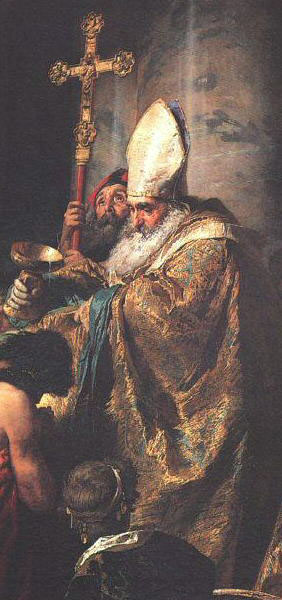
St. George


If Mary Magdalene was the victim of misunderstanding, George is the object of a vast amount of imagination. There is every reason to believe that he was a real martyr who suffered at Lydda in Palestine, probably before the time of Constantine. The Church adheres to his memory, but not to the legends surrounding his life. That he was willing to pay the supreme price to follow Christ is what the Church believes. And it is enough. The story of George's slaying the dragon, rescuing the king's daughter and converting Libya is a twelfth-century Italian fable. George was a favourite patron saint of crusaders, as well as of Eastern soldiers in earlier times. He is a patron saint of England, Portugal, Germany, Aragon, Catalonia, Genoa and Venice.


The Holy Gospel of Jesus Christ according to Saint John (6.52~59)


Then the Jews began to argue sharply among themselves, "How can this man give us his flesh to eat?" Jesus said to them, "I tell you the truth, unless you eat the flesh of the Son of Man and drink His Blood, you have no life in you. Whoever eats My Flesh and drinks My Blood has eternal life, and I will raise him up at the last day. For My Flesh is real food and My Blood is real drink. Whoever eats My Flesh and drinks My Blood remains in Me, and I in him. Just as the living Father sent Me and I live because of the Father, so the one who feeds on Me will live because of Me. This is the bread that came down from heaven. Your forefathers ate manna and died, but he who feeds on this bread will live for ever." He said this while teaching in the synagogue in Capernaum.


The Eucharist
(Homily by Fr. E.J. Tyler)

The Oxford Movement of the third decade of nineteenth century England strove to defend intellectually the dogmatic character of Christianity against a growing liberalism that eschewed revealed dogma as rationally unsustainable. It insisted on the inviolable character of revealed dogma, and on the uniqueness of revealed religion. Revealed religion could not be reduced to what might be called the Natural Religion which is evidenced across the sweep of human history and society. However, this was not to say that the only form of divine revelation was the Judaeo-Christian Revelation — as recorded in the inspired Old and New Testaments. John Henry Newman firmly taught that there was a universal revelation, which is to say that the religions of man contained — together with their errors — certain tenets which in one way or another God had been revealing to the peoples. This universal revelation was not authenticated, but its presence could be judged by the yardstick of Judaeo-Christian Revelation which was authenticated. From the Christian perspective, this point could be granted in respect to, say, certain teachings of Islam on the One God and his absolute transcendence. There is no god but the One God of Abraham. I refer to this teaching, perfectly true as far as it goes, as an introduction to our Gospel today. There is no other god but the Lord and he dwells in light inaccessible. He is beyond. But if this is all that is said about God’s relationship with man and the world, then it stops far short of the fullness of his revelation. In fact it is open to the admission of numerous errors about him. For as it turns out, God is not simply beyond, above, high and utterly other. He is also unbelievably near and at one with us. He is God-with-us. He chose a people so as to prepare to make a home with both them and the world. And, breathtaking surprise! God the Son became one of us so as to be with us as our Brother. More still! The God who is our Brother bore on his shoulders the sins of each of us and died to set us free from them. He rose, returned to the right hand of his heavenly Father, and by their joint gift of the Spirit, brought each of us who are baptized into union with the three divine Persons.

God is thus revealed as a God who loves and serves. He kneels before his friends as represented in the Twelve, and washes their feet, going on from there to die for them. But especially amazing is his ongoing gift which is revealed in our Gospel passage today. “Jesus said to them, I tell you the truth, unless you eat the flesh of the Son of Man and drink his blood, you have no life in you. Whoever eats my flesh and drinks my blood has eternal life, and I will raise him up at the last day. For my flesh is real food and my blood is real drink. Whoever eats my flesh and drinks my blood remains in me, and I in him.” Let us remember that our Lord’s unique words on this are uttered publicly. Were we to have had only the first three gospels (called the “synoptics” because of their likeness to one another), we may have thought that it was only in the privacy of the Last Supper that our Lord revealed the stunning gift of the Eucharist. But not so. It was revealed in the full light of day, publicly, in a synagogue — the synagogue of Capernaum. Our Lord did not even “tone it down” by explaining that the gift of his flesh as food would be in a sacramental mode. It was the starkest of statements. If they were to live, they must eat his flesh and drink his blood. The one who eats his flesh will be raised up by him at the last day. He is not speaking metaphorically, he insists. My flesh is real food and my blood is real drink (John 6:52-59). Nothing like this had ever been said before, let alone publicly for it to be reported everywhere — and perhaps distorted and used by his enemies. It was a daring and unprecedented announcement and was, in fact, a fundamental teaching of the new revelation by Jesus Christ. God — the God of light inaccessible — was pouring himself out for man as their very food. He was not only before them as their Brother, but he was becoming much nearer still. He was, as their Brother and their God, making himself their very sustenance. They were to feed on him, and in this way they would live forever. It is an ultimate revelation of the love of God. God is utter love. How beautiful is God!

The Holy Eucharist, coming to us in the life and the ministry of the Church which is the mystical body of Christ, is our principal means of union with the God of all heights. “Whoever eats my flesh and drinks my blood remains in me, and I in him. Just as the living Father sent me and I live because of the Father, so the one who feeds on me will live because of me.” Together with the doctrines of the triune God and the Incarnation, the doctrine of the Holy Eucharist is the most remarkable religious doctrine in the history of all religions. It is the mystery of faith, and it is, in the celebration of Holy Mass, the ongoing revelation of the love of God for man.


A second reflection for Friday of the third week of Eastertide (Acts 9.1~20)


Our Precious Vocation
(Homily by Fr. E.J. Tyler)

Chesterton was a famous English lay convert of the early decades of the 20th century who became a great apologist for Catholicism. One of his written sayings was "How odd of God to choose the Jews." Apart from pointing to the special election by God of the Jews as his chosen people with a world mission, Chesterton's remark may be thought of as applicable to every vocation. Why me, and not others? Each of us is chosen by God in Christ “to be holy and full of love in his sight.” for reasons we do not know. Our vocation is precious and it is mysterious.

Consider the mysteriousness and the uniqueness of St Paul's vocation, as narrated in Acts 9:1-20. The Lord Jesus told Ananias that 'this man is my chosen instrument to bring my name before pagans and pagan kings and before the people of Israel; I myself will show him how much he himself must suffer for my name.' What sort of background did Paul have for this extraordinary calling? A seemingly poor one indeed, and scarcely to be compared with that of the Twelve. Yet he was Christ's chosen instrument. Why him? There is a great mystery here manifesting the inscrutable mercy of God and his loving power.

Each of us has a vocation, a calling that has its origins in eternity, before the world began. Each of us is the object of God's inscrutable mercy, his loving choice. Our vocation, whatever it be, is precious. Let us not squander it. Live it to the full, daily. Let us meditate at length on the calling of St Paul.


Character

Serenity. Why lose your temper if by losing it you offend God, you trouble your neighbour, you give yourself a bad time...and in the end you have to set things aright anyway?

(The Way, no 8)

Thursday, April 22, 2010

Prayers today: Let us sing to the Lord, he has covered himself in glory! The Lord is my strength, and I praise him: he is the Saviour of my life, alleluia. (Ex 15. 1~2)

Father, in this holy season we come to know the full depth of your love. You have freed us from the darkness of error and sin. Help us to cling to your truths with fidelity. We ask this through our Lord Jesus Christ, your Son, who liveth and reigneth, world without end. Amen. Alleluia.


St. Adalbert of Prague (956-97)


Opposition to the Good News of Jesus did not discourage Adalbert, who is now remembered with great honour in the Czech Republic, Poland, Hungary and Germany. Born to a noble family in Bohemia, he received part of his education from St. Adalbert of Magdeburg. At the age of 27 he was chosen as bishop of Prague. Those who resisted his program of clerical reform forced him into exile eight years later. In time, the people of Prague requested his return as their bishop. Within a short time, however, he was exiled again after excommunicating those who violated the right of sanctuary by dragging a woman accused of adultery from a church and murdering her. After a short ministry in Hungary, he went to preach the Good News to people living near the Baltic Sea. He and two companions were martyred by pagan priests in that region. Adalbert's body was immediately ransomed and buried in Gniezno cathedral (Poland). In the mid-11th century his relics were moved to St. Vitus Cathedral in Prague.


The Holy Gospel of Jesus Christ according to Saint John (6.44~51)


Jesus said, "No one can come to Me unless the Father who sent Me draws him, and I will raise Him up at the last day. It is written in the Prophets: 'They will all be taught by God.' Everyone who listens to the Father and learns from Him comes to Me. No one has seen the Father except the One who is from God; only He has seen the Father. I tell you the truth, he who believes has everlasting life. I am the bread of life. Your forefathers ate the manna in the desert, yet they died. But here is the bread that comes down from heaven, which a man may eat and not die. I am the living bread that came down from heaven. If anyone eats of this bread, he will live for ever. This bread is My Flesh, which I will give for the life of the world."


His Flesh
(Homily by Fr. E.J. Tyler)

Our Lord had said prior to our passage today that the one who comes to him will never hunger, and the one who believes in him will never thirst. He has come from heaven as the One sent by the Father in order to give everlasting life to all who believe in him (John 6: 35-40). He is the One to whom they ought come in order to have life. They object to his exalted claims — they know him and they knew his parents. How can he say that he has come down from heaven? In his answer our Lord warns that they will not be able to come to him — no one will have the power to do so (oudeis dunatai elthein) — unless the Father should draw him. That is to say, a special grace is required to be able to come to Jesus and believe in him. The implication is that their murmuring at our Lord’s teaching is a sign that they are not sufficiently in a state of divine grace. We remember how the Angel Gabriel when coming into the presence of the Virgin Mary addressed her as being “full of grace.” The Lord was with her — meaning that the Father was with her. Now, what was the upshot of her union with God? It showed itself in her faith. Once she understood what was being asked of her, her reply was immediate: “Behold the handmaid of the Lord. Be it done unto me according to your word.” She was full of grace; the Lord was with her, and her response was one of obedient faith. She may be looked to as the pattern of what our Lord speaks of in our passage today: “Everyone who listens to the Father and learns from him comes to me.” If we are looking to God; if we are listening to him with an obedient faith; if we are subject to the action and grace of God, we shall come to Jesus. A prior disposition of heart, an existing relationship with God, is therefore required if a person is to come to Jesus and receive from him the life eternal which is his gift. The niggardly and grumbling response to our Lord’s teaching about himself is a sign that they are not listening to the Father in their lives. Their negative response to the word of Jesus was a sign that they lacked true religion.

It soon becomes more evident that belief requires a grace and a disposition beyond the natural, because the revelation which now begins to be given is astonishing and absolutely unprecedented. Our Lord has spoken of himself as having been sent by the Father and as having come down from heaven. That he gave the impression of meaning this literally is shown by their response that this could not be, because they knew where he came from and also who his parents were. He compares himself with the manna that God had sent to give them food and life while in the desert. So our Lord repeats what he has said: “I am the bread of life.” Moreover, while their fathers had the manna to eat in the desert, they all died. The bread from heaven that is our Lord himself will bring life everlasting. “Your forefathers ate the manna in the desert, yet they died. But here is the bread that comes down from heaven, which a man may eat and not die. I am the living bread that came down from heaven. If anyone eats of this bread, he will live for ever.” Whatever of the manna in the desert, this is magnificent bread, the bread of life indeed, an extraordinary gift from God. But there is more, for to refer to himself as “the bread of life” with an evocation of the memory of the manna in the desert is to use a slightly vague expression. Christ’s being “the bread of life” could have meant his teaching; it could have meant his never-to-be-forgotten example; or it could have meant his life-giving friendship. But no — it was all of these things of course, but over and above them all it meant something far more striking and, indeed, startling. The “bread” which had come down from heaven and which was the person of Jesus himself was his very flesh. “I am the living bread that came down from heaven. If anyone eats of this bread, he will live for ever. This bread is my flesh, which I will give for the life of the world” (John 6:44-51). So while their forefathers ate the manna in the desert and yet eventually died, from now on eternal life will be offered with the food that is Christ. That food is his flesh.

Nothing like this had ever been said by any prophet before him. It was utterly new — but of course with distant types of it and pointers to it in the religion, beliefs, and ritual of the Old Testament. No other prophet had claimed to be the bread from heaven that would give eternal life to the world, and that this bread would be his own flesh. Our Lord’s words must have been a sensation, and must have caused a tremendous stir. It was the mystery of mysteries connected with his person. In all of his mounting witness to his own person and teaching, this act of witness is perhaps the most signal. The true bread of heaven would be the flesh of Jesus of Nazareth. What on earth did he mean? His uncompromising explanation would follow.


Character

Don't have a "small town" outlook. Enlarge your heart until it becomes universal~"catholic."

Don't fly like a barnyard hen when you can soar like an eagle.
(The Way, no. 7)

Wednesday, April 21, 2010

Prayers today: Fill me with your praise and I will sing your glory; songs of joy will be on my lips, alleluia. (Ps 70:8, 23)

Merciful Lord, hear the prayers of your people. May we who have received your gift of faith share for ever in the new life of Christ. Grant this through our Lord Jesus Christ, your Son, who liveth and reigneth world without end. Amen. Alleluia.


St. Anselm (1033-1109)


Indifferent toward religion as a young man, Anselm became one of the Church's greatest theologians and leaders. He received the title "Father of Scholasticism" for his attempt to analyse and illumine the truths of faith through the aid of reason. At 15, Anselm wanted to enter a monastery, but was refused acceptance because of his father's opposition. Twelve years later, after careless disinterest in religion and years of worldly living, he finally fulfilled his desire to be a monk. He entered the monastery of Bec in Normandy, three years later was elected prior and 15 years later was unanimously chosen abbot. Considered an original and independent thinker, Anselm was admired for his patience, gentleness and teaching skill. Under his leadership, the abbey of Bec became a monastic school, influential in philosophical and theological studies. During these years, at the community's request, Anselm began publishing his theological works, comparable to those of St. Augustine. His best-known work is the book Cur Deus Homo ("Why God Became Man"). At 60, against his will, Anselm was appointed archbishop of Canterbury in 1093. His appointment was opposed at first by England's King William Rufus and later accepted. Rufus persistently refused to cooperate with efforts to reform the Church. Anselm finally went into voluntary exile until Rufus died in 1100. He was then recalled to England by Rufus's brother and successor, Henry I. Disagreeing fearlessly with Henry over the king's insistence on investing England's bishops, Anselm spent another three years in exile in Rome. His care and concern extended to the very poorest people; he opposed the slave trade. Anselm obtained from the national council at Westminster the passage of a resolution prohibiting the sale of human beings.
"No one will have any other desire in heaven than what God wills; and the desire of one will be the desire of all; and the desire of all and of each one will also be the desire of God" (St. Anselm, Letter 112).


The Holy Gospel of Jesus Christ according to Saint John (6.35~40)

Then Jesus declared, I am the bread of life. He who comes to me will never go hungry, and he who believes in me will never be thirsty. But as I told you, you have seen me and still you do not believe. All that the Father gives me will come to me, and whoever comes to me I will never drive away. For I have come down from heaven not to do my will but to do the will of him who sent me. And this is the will of him who sent me, that I shall lose none of all that he has given me, but raise them up at the last day. For my Father's will is that everyone who looks to the Son and believes in him shall have eternal life, and I will raise him up at the last day.


Come to Him!
(Homily by Fr. E.J. Tyler)

The world seems to be marked by unending vicissitudes. Wars break out and reach their conclusion, civil strife erupts, earthquakes bring incalculable damage to life and property, numerous banks begin to fail as debtors across a nation default en masse, famine and disease strikes this or that country, and so the sorry tale goes on. In his great Apologia pro Vita Sua, written in 1864, John Henry Newman writes, “I look out of myself into the world of men, and there I see a sight which fills me with unspeakable distress. .... The sight of the world is nothing else than the prophet’s scroll, full of ‘lamentation, and mourning, and woe.’” Newman writes of the “aimless courses .... the greatness and littleness of man... the curtain hung over his futurity, the disappointments of life, the defeat of good, the success of evil, physical pain, mental anguish, the prevalence and intensity of sin, the pervading idolatries, the corruptions, the dreary hopeless irreligion, that condition of the whole race.. all this is a vision to dizzy and appal” (ch. V). It is, we might say, an unending struggle to keep “head above water.” There is just no simple solution to the suffering and evil of the world. There is no one key, no single formula that will “fix it” for man. Now this entire phenomena of a broken world constantly being sucked towards death and all that leads to death is but the manifestation and fruit of the deeper catastrophe of sin. We know the cause of the world’s broken condition because it has been revealed to us. It is due to sin, the sin of man at the very beginning. The flawed character of so much of human history merely shows the enormity of sin which is its original and ongoing cause. If the evils of the world are so extensive as to defy man’s efforts at a solution, what could possibly be said of a remedy being found for its very source which is sin? Ah! the Remedy has come, and whatever be the complexity of evil and suffering, together with the prospects for individuals and all of humanity together, in a very real sense the Remedy is remarkably simple. God has given the Remedy.

There is one thing which every man and woman is called to do in order to deal in ultimate terms with his or her condition and prospects. The ultimate answer is to come to Jesus in faith. At times a thought might come to us that it would have been so much easier to have seen Jesus and to have come to him in a directly physical sense. Now we cannot see him. We have to come to him in faith. But notice what our Lord says in our passage today, that “as I told you, you have seen me and still you do not believe.” There were many who saw him and who did not believe. There was one who was called to live with him, to be with him constantly, to be his companion, to share actively in his mission, to receive some of his powers such as that of healing, and yet he not only left him but positively betrayed him. Having had the inestimable opportunity of seeing the Incarnate Son of God did not assure that a person would gain faith. The ultimate answer to man’s dubious situation so fraught with threat and sin is to come to Jesus in faith. The answer is simple, though very demanding in its consequences: “I am the bread of life. He who comes to me will never go hungry, and he who believes in me will never be thirsty.” The one who comes to Jesus in faith has received the grace to belong to Jesus, for our Lord says that “All that the Father gives me will come to me, and whoever comes to me I will never drive away.” We are the Father’s gift to Jesus, and he will receive us into his friendship. Moreover, the divine plan is to care for us and to raise us to eternal life with him forever. “For I have come down from heaven not to do my will but to do the will of him who sent me. And this is the will of him who sent me, that I shall lose none of all that he has given me, but raise them up at the last day.” Christ is determined not to lose any of us but to save us from all that could do us ultimate harm. He wishes each of us to live forever in him. “For my Father's will is that everyone who looks to the Son and believes in him shall have eternal life, and I will raise him up at the last day” (John 6:35-40).

As opposed to the tangle and mystery of the problems of life and the world, there is a simple Remedy. It is simple in its direction, but immense in its consequences. The way ahead, the Remedy to be applied, is to come to Jesus in faith and to give oneself to him. It is to act on the grace of faith and to resolve to belong to him. If we belong to Jesus and live out our lives according to this self-donation, then Jesus will care for us. He will not lose us. He will raise us up to be with him forever. The way ahead is clear — so let us take it, then


Second reflection for Wednesday of the third week of Eastertide


Trust in God
(Homily by Fr. E,J. Tyler)

In today’s gospel passage our Lord declares that it is the Father's will that he should lose nothing of what the Father had given to him (John 6: 39). This should be the source of a great sense of security: no circumstances need destroy or weaken that all-important relationship which we have been given with Christ. We see an instance of this played out in the first reading (Acts of the Apostles 8: 1-8). With Stephen stoned to death, Saul began a furious persecution of the infant Church, scattering the Christians from Jerusalem. But what was the upshot of this? The fleeing disciples went from place to place preaching the Good News. The persecution was the direct cause of more and more coming to know the Lord. Perhaps the greatest sequel of all was the conversion of Saul himself. In the midst of great tribulation the hand of the Lord was upon the Church. As Paul would write in one of his Letters, nothing can come between us and the love of God in Christ. So we should face adversity with trust in the power of God, determined to use the adversity to further the plan of God in our regard. As Pope John Paul II used repeatedly to say, Be not afraid!

Character


Turn your back on the deceiver when he whispers in your ear, "Why complicate your life?"

(The Way, no. 6)

Tuesday, April 20, 2010

Prayers today: All you who fear God, both the great and the small, give praise to him! For his salvation and strength have come, the power of Christ, alleluia. (Rv 19:5; 12:10)

Father, you open the kingdom of heaven to those born again by water and the Spirit. Increase your gift of love in us. May all who have been freed from sins in baptism receive all that you have promised. We ask this through our Lord Jesus Christ, your Son, who liveth and reigneth world without end. Amen. Alleluia.


St. Conrad of Parzham (1818-1894)


Conrad spent most of his life as porter in Altoetting, Bavaria, letting people into the friary and indirectly encouraging them to let God into their lives. His parents, Bartholomew and Gertrude Birndorfer, lived near Parzham, Bavaria. In those days this region was recovering from the Napoleonic wars. A lover of solitary prayer and a peacemaker as a young man, Conrad joined the Capuchins as a brother. He made his profession in 1852 and was assigned to the friary in Altoetting. That city’s shrine to Mary was very popular; at the nearby Capuchin friary there was a lot of work for the porter, a job Conrad held for 41 years. At first some of the other friars were jealous that such a young friar held this important job. Conrad’s patience and holy life overcame their doubts. As porter he dealt with many people, obtaining many of the friary supplies and generously providing for the poor who came to the door. He treated them all with the courtesy Francis expected of his followers. Conrad’s helpfulness was sometimes unnerving. Once Father Vincent, seeking quiet to prepare a sermon, went up the belltower of the church. Conrad tracked him down when someone wanting to go to confession specifically requested Father Vincent. Conrad also developed a special rapport with the children of the area. He enthusiastically promoted the Seraphic Work of Charity, which aided neglected children. Conrad spent hours in prayer before the Blessed Sacrament. He regularly asked the Blessed Mother to intercede for him and for the many people he included in his prayers. The ever-patient Conrad was canonized in 1934.


The Holy Gospel of Jesus Christ according to Saint John (6.30~35)
So they asked Jesus, "What sign then will you give that we may see it and believe you? What will you do? Our forefathers ate the manna in the desert; as it is written: 'He gave them bread from heaven to eat.'" Jesus said to them, "I tell you the truth, it is not Moses who has given you the bread from heaven, but it is My Father who gives you the true bread from heaven. For the bread of God is He who comes down from heaven and gives life to the world. "Sir," they said, "from now on give us this bread." Then Jesus declared, "I am the bread of life. He who comes to Me will never go hungry, and He who believes in Me will never be thirsty."


The True Bread
(Homily by Fr. E.J. Tyler)

If there is one thing which is obvious from a reading of the Old Testament it is the defining character of the Exodus events. The departure from Egypt, the years in the wilderness, and the entry into the Promised Land, profoundly shaped the religious outlook of the children of Israel. So marked is this memory as evidenced in the Old Testament Scriptures, that one cannot but be a little sceptical of the weight given by many to the current lack of archaeological evidence for the great events referred to in the Hebrew Scriptures. Where is the archaeological evidence, it is urged, for the event of the departure from Egypt, the long sojourn in the wilderness, the mass invasion by Israel of the land of Canaan — and for other supposed facts such as the career of David, Solomon, and so forth? While there is a present lack of that kind of evidence, there is the fact of the great memory by the chosen people, so manifest in their Scriptures. The nation was shaped by this memory, and our Lord himself, true God and true man, refers explicitly to these past historical events. In our very passage today he refers to Moses and to the manna he gave from heaven. I make these points simply to stress how much the Exodus events were a criterion of religious truth for the children of Israel. Our Gospel scene today (John 6:30-35) opens with the crowds making a demand of Jesus. He had told them that the work that God asked of them was to believe in him. To this they responded, “What sign then will you give that we may see it and believe you? What will you do? Our forefathers ate the manna in the desert; as it is written: 'He gave them bread from heaven to eat.'” In the desert, Moses fed the people with manna from heaven for their entire sojourn. You, Jesus of Nazareth, have multiplied the loaves and the fish, could you not do what Moses did, and feed us continually with bread from heaven? What sign will you do that we may see and believe you? Our Lord replies by pointing prophetically to what will be the true bread from heaven — his own person.

Though the manna which Israel received in the desert came from God in answer to the prayer of Moses, it was not heavenly food. It was earthly and served to sustain life on earth. It was a material substance which modern scholars have even attempted to identify. Some suggest it was the resin from the Tamarisk tree, others a form of plant lice, or the thalli of certain lichens, or Psilocybe cubensis mushrooms, or a kosher species of locust, or the sap of certain succulent plants. The manna in the desert had the powers of material food — it was God’s miraculous gift of earthly food. Our Lord says that the true bread of God is heavenly. It does indeed come down from heaven and give life to the world. It is heavenly bread which gives life forever and to all mankind. The manna in the desert had none of these powers. This is a remarkable announcement which those who are fully familiar with the doctrine of the Eucharist may take too much for granted. Our Lord is heralding an extraordinary food for the journey. He is acting as a new Moses for the children of Israel, and for all of mankind. A new sustenance is coming for all. As Moses, by God’s power, provided earthly food for the journey of the children of Israel, so Jesus Christ will provide heavenly food for the journey of the whole world. It will be the true bread from heaven, the bread that manna prefigured. Manna was merely a pointer to the true bread from heaven that would take all of humanity to life in God and heaven. What is this heavenly food? “Sir, they said, from now on give us this bread. Then Jesus declared, I am the bread of life. He who comes to me will never go hungry, and he who believes in me will never be thirsty” (John 6:30-35). Our Lord calmly and publicly makes a breathtaking claim which had no precedent in all of the Scriptures, and which placed himself far above all. He himself is the bread of life that God has sent from heaven. It is he himself who gives life to the whole world. He is the answer to true hunger and true thirst. If a person lives on him, his true hunger will be satisfied.

Our Lord is placing himself at the very centre of revealed religion. Never before had certain things been said that Jesus Christ was now saying. He is himself the heart and soul of true religion, and a person who lives on him and in him will possess a heavenly life that is far more than this terrestrial life. In order to live, in order to survive the journey through the wilderness of life, we must go to Jesus. Whoever comes to me will never go hungry. He is the source of life, life here and life everlasting. He is speaking as God would speak. Let us then look on Jesus Christ as our all. If we truly possess him by our love and our faith, by our devout hearing of his word from the Church, and by our sincere reception of him in the Sacraments, life will be ours forever.


Character


Get used to saying No.

(The Way, no. 5)

Monday, April 19, 2010

Prayers today: The Good Shepherd is risen! He who laid down his life for his sheep, who died for his flock, he is risen, alleluia.

God our Father, your light of truth guides us to the way of Christ. May all who follow him reject what is contrary’ to the gospel. We ask this through our Lord Jesus Christ, your Son, who liveth and reigneth, world without end. Amen. Alleluia.

Blessed Luchesio and Buonadonna (d.1260)


Luchesio and his wife Buonadonna wanted to follow St. Francis as a married couple. Thus they set in motion the Secular Franciscan Order.

Luchesio and Buonadonna lived in Poggibonzi where he was a greedy merchant. Meeting Francis—probably in 1213—changed his life. He began to perform many works of charity.

At first Buonadonna was not as enthusiastic about giving so much away as Luchesio was. One day after complaining that he was giving everything to strangers, Buonadonna answered the door only to find someone else needing help. Luchesio asked her to give the poor man some bread. She frowned but went to the pantry anyway. There she discovered more bread than had been there the last time she looked. She soon became as zealous for a poor and simple life as Luchesio was. They sold the business, farmed enough land to provide for their needs and distributed the rest to the poor.


In the 13th century some couples, by mutual consent and with the Church’s permission, separated so that the husband could join a monastery (or a group such as Francis began) and his wife could go to a cloister. Conrad of Piacenza and his wife did just that. This choice existed for childless couples or for those whose children had already grown up. Luchesio and Buonadonna wanted another alternative, a way of sharing in religious life, but outside the cloister.

To meet this desire, Francis set up the Secular Franciscan Order. Francis wrote a simple Rule for the Third Order (Secular Franciscans) at first; Pope Honorius III approved a more formally worded Rule in 1221.

The charity of Luchesio drew the poor to him, and, like many other saints, he and Buonadonna seemed never to lack the resources to help these people.

One day Luchesio was carrying a crippled man he had found on the road. A frivolous young man came up and asked, "What poor devil is that you are carrying there on your back?" "I am carrying my Lord Jesus Christ," responded Luchesio. The young man immediately begged Luchesio’s pardon.

Luchesio and Buonadonna both died on April 28, 1260. He was beatified in 1273. Local tradition referred to Buonadonna as "blessed" though the title was not given officially.

The Holy Gospel of Jesus Christ according to Saint John (6.22~29)


The next day the crowd that had stayed on the opposite shore of the lake realised that only one boat had been there, and that Jesus had not entered it with His disciples, but that they had gone away alone. Then some boats from Tiberias landed near the place where the people had eaten the bread after the Lord had given thanks. Once the crowd realised that neither Jesus nor His disciples were there, they got into the boats and went to Capernaum in search of Jesus. When they found Him on the other side of the lake, they asked Him, "Rabbi, when did you get here?" Jesus answered, "I tell you the truth, you are looking for Me, not because you saw miraculous signs but because you ate the loaves and had your fill. Do not work for food that spoils, but for food that endures to eternal life, which the Son of Man will give you. On Him God the Father has placed His seal of approval." Then they asked Him, "What must we do to do the works God requires?" Jesus answered, "The work of God is this: to believe in the one He has sent."


The Work of Works
(Homily by Fr. E.J. Tyler)

One of the notable features of the modern university is its abundance and variety of degree programs. There is scarcely a field of human activity that cannot be studied at a university. It was not alway so. Up to the beginning of the nineteenth century there was at Oxford, for instance, an overwhelming stress on Mathematics and the Greek and Latin Classics. An indicator of the change that was coming was the foundation of the professorship of political economy at Oxford in 1825, with Nassau William Senior being elected to fill the chair. At present, one of the most dominant disciplines at tertiary level is Economics, and this stands to reason because Economics is one of the most dominant interests of Western culture. Consider the space given to economic and commercial matters in the printed press and in television and radio news. This of itself is not to be regretted because of the fundamental importance of the material dimension to life. Man must live off his material resources, and so it is of immense importance that his material resources be harvested and adequately organized — and this is what Economics is all about. Famine, disease and material deprivation rage in various parts of the world, and the world has a responsibility to provide economic security for the family of man. We must get our economics right and for this reason the Church has an extensive theological teaching on the economic life of society. That having been said, our special danger is to look to economic security and wellbeing as the key to true security and happiness. If only we are economically healthy and secure, all will be well. If we are not, then whatever else we might have, it is all flawed. This viewpoint has always been the danger for man and society, but in the past it has not endangered the acceptance of religion. Societies have pursued economic progress, but have also endeavoured to be in favour with the gods — or God. Now in a secular culture, though, we tend to dispense with God and place our hopes in material and economic progress alone. We aspire for food that will not last.

This has always been a danger, and our Lord refers to it directly in our Gospel today. The day before he had worked a spectacular miracle, a “sign” of what was coming. He had fed thousands with a mere handful of food and had gathered up many baskets of the fragments remaining. He had shown that he could provide sustenance for the multitudes, but it was meant by him as a sign of the special heavenly sustenance he would bestow on the world. That food from heaven would be his own Self, his body given for the life of the world. All that the multitude took from it, though, was a great sign of coming material security. They would scarcely need to work, with Christ in their midst! The day had ended with their eating to their full, with delicious bread and fish (for we remember the delicious wine, changed from water at the wedding feast of Cana). But the next day they discovered that Jesus had gone and they hastened back to Capernaum and discovered him there. How did you get here, they asked him? Our Lord did not bother with an answer to that question. The only reason why they were looking for him, he replied, was because they had been satisfied materially. They had had their fill, and they wanted more of the same. Their following of him, their seeking after him, was for material purposes. They were not seeking the salvation of their souls. They were concerned only with the food that cannot last. “Do not work for food that spoils, but for food that endures to eternal life, which the Son of Man will give you.” But then comes the central question of the passage: “Then they asked him, What must we do to do the works God requires?” That is to say, what is the central work that God asks of us? What is it that humanity must achieve most of all? It is not just to be religious — for, after all, most of humanity in its long history has been “religious.” What humanity must do more than anything is believe in the one whom God has sent. “Jesus answered, The work of God is this: to believe in the one he has sent” (John 6:22-29).

Just before he ascended into heaven, our Lord gave to his disciples — which is to say, to the Church — a solemn charge. It was to go to the whole world and make disciples of all the nations. This is the work of the Church, to believe in Jesus Christ and to bring mankind to that belief. This is the work par excellence of man, to believe in Jesus Christ. The religion of Jesus Christ is not just one religion among many — all of them representing man’s aspiration for the divine. Jesus Christ is the one sent by God to save fallen man and to bring him into union with the One for whom he longs. Our work in life is to be united in faith with Jesus Christ. Our fulfilment will be attained in this. All other activity — all other work we do — must be understood and pursued in the context of this primary work. So then, now I begin!


Character

Don't say, "That's the way I am - it's my character." It's your lack of character. Esto vir! - Be a man!

(The Way, no. 4)


Sunday, April 18, 2010

Prayers for today: Let all the earth cry out to God with joy; praise the glory of his name; proclaim his glorious praise, alleluia. (Psalm 65: 1-2)

God our Father, may we look forward with hope to our resurrection, for you have made us your sons and daughters, and restored the joy of our youth. We ask this through our Lord Jesus Christ your Son who lives and reigns with you and the Holy Spirit, one God for ever and ever. Amen. Alleluia.


Blessed James Oldo (1364-1404)


James of Oldo was born in 1364, into a well-to-do family near Milan. He married a woman who, like him, appreciated the comforts that came with wealth. But an outbreak of plague drove James, his wife and their three children out of their home and into the countryside. Despite those precautions, two of his daughters died from the plague, James determined to use whatever time he had left to build up treasures in heaven and to build God’s realm on earth. He and his wife became Secular Franciscans. James gave up his old lifestyle and did penance for his sins. He cared for a sick priest, who taught him Latin. Upon the death of his wife, James himself became a priest. His house was transformed into a chapel where small groups of people, many of them fellow Secular Franciscans, came for prayer and support. James focused on caring for the sick and for prisoners of war. He died in 1404 after contracting a disease from one of his patients. James Oldo was beatified in 1933.


The Holy Gospel of Jesus Christ according to Saint John (21.1~19)
Afterwards Jesus appeared again to His disciples, by the Sea of Tiberias. It happened this way: Simon Peter, Thomas (called Didymus), Nathanael from Cana in Galilee, the sons of Zebedee, and two other disciples were together. "I'm going out to fish," Simon Peter told them, and they said, "We'll go with you." So they went out and got into the boat, but that night they caught nothing. Early in the morning, Jesus stood on the shore, but the disciples did not realise that it was Jesus. He called out to them, "Friends, haven't you any fish?" "No," they answered. He said, "Throw your net on the right side of the boat and you will find some." When they did, they were unable to haul the net in because of the large number of fish. Then the disciple whom Jesus loved said to Peter, "It is the Lord!" As soon as Simon Peter heard him say, "It is the Lord," he wrapped his outer garment around him (for he had taken it off) and jumped into the water. The other disciples followed in the boat, towing the net full of fish, for they were not far from shore, about a hundred yards. Then they landed, they saw a fire of burning coals there with fish on it, and some bread. Jesus said to them, "Bring some of the fish you have just caught." Simon Peter climbed aboard and dragged the net ashore. It was full of large fish, but even with so many the net was not torn. Jesus said to them, "Come and have breakfast." None of the disciples dared ask Him, "Who are you?" They knew it was the Lord. Jesus came, took the bread and gave it to them, and did the same with the fish. This was now the third time Jesus appeared to His disciples after He was raised from the dead. When they had finished eating, Jesus said to Simon Peter, "Simon son of John, do you truly love Me more than these?" "Yes, Lord," he said, "you know that I love you." Jesus said, "Feed my lambs." Again Jesus said, "Simon son of John, do you truly love me?" He answered, "Yes, Lord, you know that I love you." Jesus said, "Take care of my sheep." The third time He said to him, "Simon son of John, do you love me?" Peter was hurt because Jesus asked him the third time, "Do you love me?" He said, "Lord, you know all things; You know that I love You." Jesus said, "Feed my sheep. I tell you the truth, when you were younger you dressed yourself and went where you wanted; but when you are old you will stretch out your hands, and someone else will dress you and lead you where you do not want to go." Jesus said this to indicate the kind of death by which Peter would glorify God. Then He said to him, "Follow me!"


The Resurrection
(Homily by Fr. E.J. Tyler)

The Oxford Movement in the third decade of nineteenth century England was, among other things, an attempt to restore the authority and spiritual life of the Anglican Church. This was understood by its leaders as requiring a recovery of the Catholic ethos of the early Church, as interpreted theologically by the Caroline divines of the seventeenth century. All acknowledge that John Henry Newman was its driving intellectual leader, and the elements of his thought continue to be the object of widespread research. Now, Newman saw clearly that the foe of Christian faith in his time was Rationalism. The rationalism that Newman opposed insisted that the validity of Faith and its tenets must be judged by the requirements of so-called “Reason.” In effect, “Reason” meant the formal requirements of logic and demonstration, such that if the believer could not demonstrate his case according to the canons of scientific proof, his case could not stand. Newman opposed this notion of the reasonable as being unreal. It was not how human beings arrived at valid convictions. The human being becomes convinced of something not just because it can be “demonstrated,” but because of a host of factors that are usually impossible to put into syllogistic form. Perhaps the most important factor (among others) leading a person to be convinced of the truth of something is antecedent probability. A formal “demonstration” of the existence of God, which might satisfy the demands of formal logic, of itself and alone will not usually lead to personal conviction of its truth. Rather, what will be decisive will be the convergence of factors which, while in logic might be probabilities, amount in his judgment (i.e., according to his “reason”) to a certainty. Newman also said that in matters moral and religious, what a person perceives to be true will depend in large measure on his own moral state — the state of his heart, of his will. This in turn depends on his fidelity to duty. What I am highlighting in this reference to Newman here is the importance of antecedent probability in arriving at religious truth, and of the state of a person’s heart in what he expects to be the truth.

We have a beautiful Gospel scene before us today John 21:1-19, the scene of the risen Jesus on the shore of the Sea of Galilee. There he is as dawn is breaking, a lone figure whom the disciples see from their boat. He is soon recognized by the beloved disciple, but this recognition followed on their encounter with the risen Jesus back in Jerusalem on the day of his resurrection. Our scene today invites us to recall the frame of mind of our Lord’s closest disciples, his Apostles no less, following his terrible death and hasty burial on the Friday afternoon. A great gloom enveloped them and during the entire Sabbath day that followed, a great darkness covered their souls. It was well represented by the two forlorn disciples leaving Jerusalem for Emmaus on the Sunday morning. They were joined by the risen Jesus, but failed to recognize him. The striking thing about the entire group of disciples — with the exception, we may be sure, of Christ’s own mother — was their conviction that his death was the end. They did not have the slightest sense of the probability of his rising from the dead. He had spoken of this explicitly. He had foretold his rejection, his condemnation, his passion, his death — and had even foretold how he would die. It would be by crucifixion. But he had repeatedly said he would also rise — and had specified that it would be on the third day. Nevertheless, they had no sense even of its probability, let alone of its certainty. They utterly lacked what Newman says is the principal factor leading to conviction in matters of real life; a sense of its antecedent probability. Not only did they not expect it, but they expected the opposite. Because of this they did not accept the various reports coming from reliable witnesses on the day of his resurrection. They regarded it as overwhelmingly improbable, despite all they had seen and known of Jesus Christ and of what he had predicted. Thomas even refused to accept the joint witness of the other Apostles. Why did they regard it as so improbable? Our Lord made it clear to them that it was due to the hardness of their hearts.

As I mentioned earlier, Newman also taught that in matters moral and religious, what a person accepts as likely will depend on his moral state. Religious conviction — or faith — does not just depend on so-called “Reason.” It depends on the state of our hearts, for this will shape what we consider to be probable. In turn, our sense of what is probable will shape our response to those many things that point to the truth of something. It was because of the state of their hearts that the Apostles did not accept the news of the resurrection — in other words, the good news of the Gospel. They regarded it as totally improbable. It was only when the Fact of it was presented before their eyes that they became convinced. Let us ask our Lord to pour his grace into our hearts and make of them good soil for the great truth of the resurrection.


Character

Maturity. Stop making faces and acting like a child! Your bearing ought to reflect the peace and order in your soul.

(The Way, no. 3)

Saturday, April 17, 2010

Prayers today: You are a people God claims as his own, to praise him who called you out of darkness into his marvellous light, alleluia. (1 Pet 2:9)

God our Father, look upon us with love, you redeem us and make us your children in Christ. Give us true freedom and bring us to the inheritance you promised. We ask this through our Lord Jesus Christ, your Son, who liveth and reigneth world without end. Amen. Alleluia.


St. Benedict Joseph Labre (d. 1783)


Benedict Joseph Labre was truly eccentric, one of God's special little ones. Born in France and the eldest of 18 children, he studied under his uncle, a parish priest. Because of poor health and a lack of suitable academic preparation he was unsuccessful in his attempts to enter the religious life. Then, at 16 years of age, a profound change took place. Benedict lost his desire to study and gave up all thoughts of the priesthood, much to the consternation of his relatives. He became a pilgrim, travelling from one great shrine to another, living off alms. He wore the rags of a beggar and shared his food with the poor. Filled with the love of God and neighbour, Benedict had special devotion to the Blessed Mother and to the Blessed Sacrament. In Rome, where he lived in the Colosseum for a time, he was called "the poor man of the Forty Hours Devotion" and "the beggar of Rome." The people accepted his ragged appearance better than he did. His excuse to himself was that "our comfort is not in this world." On the last day of his life, April 16, 1783, Benedict Joseph dragged himself to a church in Rome and prayed there for two hours before he collapsed, dying peacefully in a nearby house. Immediately after his death the people proclaimed him a saint. He was officially proclaimed a saint by Pope Leo XIII at canonization ceremonies in 1883.


The Holy Gospel of Jesus Christ according to Saint John (6.16~21)

When evening came the disciples of Jesus went down to the sea, got into a boat and went across for Capharnaum. It was now dark, and Jesus had not yet come back to them. A strong wind blew and the sea began to stir. They had rowed some twenty five or thirty furlongs when they saw Jesus walking on the sea and approaching the boat. They were afraid, but He said to them: "It is I. Do not fear." Then they took Him on board willingly enough and very soon the boat reached the shore to which they were going.


The New Moses
(Homily by Fr. E.J. Tyler)

Our passage today is from the Gospel of St John, and one of the many connections this Gospel makes is that between Jesus Christ and Moses. At the outset of the Gospel, in its very prologue, Christ is compared with two prophets before him: John the Baptist and Moses. John the Baptist “was not the Light; he was sent to bear witness to the Light.” It is Jesus Christ who “is the true Light” (1:8-9). Through Moses “the law was given to us; through Jesus Christ grace came to us, and truth” (1:17). The hint is that Jesus Christ is a new and much greater Moses. In the sixth chapter of the Gospel, Christ gives a great “sign” that led the people present to identify him as “the Prophet who is to come into the world.” The Scriptures had pronounced that there had never been a prophet equal to Moses, and Moses himself had spoken of the Prophet who would come. They were to listen to him — suggesting that he would be a greater Prophet than Moses. The “sign” (6:14) that Christ had given of feeding the multitudes on the other side of the Sea of Tiberius away from their homes (perhaps suggesting “the wilderness”), surely conjured up the memory of Moses at the head of his people in the wilderness. Moses had appealed to God and God had sent manna from heaven. Here was a new Moses — “the Prophet,” no less. This “sign” given, our Lord presumably directs his disciples to make their way back across the Lake to Capernaum, which they proceeded to do. Evening had come, and perhaps our Lord was busy still in the ministry of the day or had withdrawn to pray. He indicated to them that he would follow, which they interpreted to mean that he would follow them in one of the other boats. So they set off across the water, and “it was already dark, but Jesus had not come to them” (6:17). Imagine the scene — “the sea was rising, because a strong wind was blowing” (6:18). Long before, the children of Israel had passed across the Red Sea with Moses at their head. The disciples are in difficulty and there before them is Jesus “walking on the sea, and drawing near to the boat” (6:19).

Moses had been the great liberator raised up by God to bring the children of Israel out of slavery to the Promised Land. He had been the redeemer of the people from the thraldom of Egypt. He had led them across the Red Sea into the wilderness, and there, as a result of his prayer to God, the people had been fed daily with manna from heaven. Thus they eventually passed through the desert into the land given by God to their forefathers and promised to them through the mouth of Moses. A new and much greater Moses has now come. There is no difficulty he cannot save us from. Whatever be the storms that beat about our craft — the craft of our own individual lives, or the craft of the Church — our Moses is always near at hand. Many times in the course of history the Church has been subjected to appalling vicissitudes. Let us think of the three centuries — three centuries! — following the death and resurrection of Christ and his command to make disciples of all the nations. There were centuries of repeated and ruthless persecutions. Then finally a springtime arrived, and it was shown that Christ had been with them on the turbulent Sea. He had been repeating to them all along, Do not be afraid. It is I! I am with you. These words of Christ to his disciples are themselves very evocative. They mirror the words of Yahweh God speaking to Moses from the Burning Bush. Moses had asked for his name so as to tell the people which God (among the various gods) had sent him. The answer was given: I am — I am who I am! Let us remember that Jesus Christ was and is the Word made flesh. Those stunning words had come from the one God, who would be revealed to be triune. That is to say, they had come from the Word, who now was flesh. Here on the turbulent water he utters them again to his disciples and through them to his Church down through the ages in the midst of their recurring vicissitudes. I am, and I am with you in the midst of everything, come what may. Significantly, when the disciples heard him they willingly received him on board, and “soon” they reached the shore.

Not only does God’s chosen people have a new liberator, a new Moses, but all of mankind does. God has sent his Son to lead his people across the sea of life and sin into the Promised Land of life in God. The new Moses is Jesus Christ, risen from the dead and now with his people as they bring this good news to all the nations. The nations have a new vocation: it is to be disciples of Jesus Christ, through whom have come grace and truth. He is always near, and he is our Saviour. Let us always hear his words, uttered once to Moses, repeated to his disciples, and passed on to us: “It is I! Do not be afraid!” (John 6:16-21)

~~~~~~~~~~~~~~~~~~~~~~~~~~~~~~~
~~~~~~~~~~~~~~~~~~~~~~~~~~~~~~~

Character


May your behaviour and your conversation be such that everyone who sees or hears you can say: This man reads the life of Jesus Christ.
(The Way, no. 2)